In REST architectures, gateways usually mediate communication. They handle routing, authentication, observability, and rate limiting, but they rarely shape the system's behaviour. Event-Driven Architectures are different.
In EDA, the broker shapes behavioural semantics. Kafka topics define scalability, ordering guarantees, replay capabilities, and retention behaviour. Schema Registries define schema evolution, compatibility rules, and message contracts. The broker and schema infrastructure become part of the behavioural model of the system itself; this changes what API Drift means in Event-Driven Architectures.
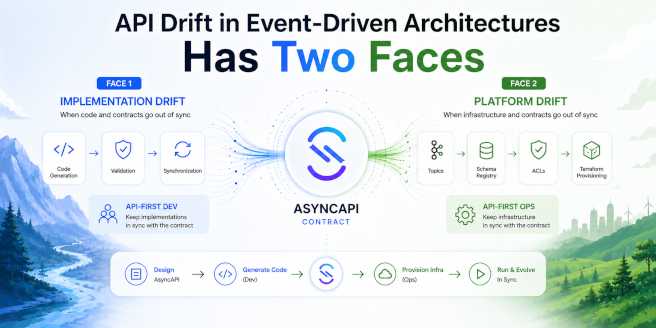
API Drift in Event-Driven Architectures is a problem with two faces.
Implementation Drift
This is the drift most teams already know:
- generated code diverges
- implementations evolve separately
- consumers rely on undocumented behaviour
- contracts and services fall out of sync
API-First development practices solve this increasingly well.
Using AsyncAPI as the canonical representation, we can:
- generate code
- validate schemas
- continuously rebuild implementations from the contract
This is API-First Dev. The contract becomes the source of truth for implementation. We can reduce implementation drift by generating read-only code on every build. If the generated code is not committed to source control and implementations are continuously rebuilt from the canonical API contract, then the specification and implementation stay synchronised by construction.
Platform Drift
In Event-Driven Architectures, infrastructure itself also drifts. Over time:
- topic configuration diverges
- retention policies evolve independently
- ACLs drift
- infrastructure and services make different assumptions
Eventually:
- the contract says one thing
- the platform runs another
- applications assume something else
This is platform drift. And unlike implementation drift, most API-First approaches still ignore it. But if the broker shapes system behaviour, then infrastructure itself must become contract-driven.
This is where API-First Ops begins. Using AsyncAPI as the operational source of truth, we can derive:
- Kafka topics
- Schema Registry subjects
- ACLs
- Terraform infrastructure
- governance validation
Directly from the API contract itself. One contract, two faces of API Drift solved together.
Tooling
These are not new ideas. The implementation side has been running in production Java and Spring shops since 2020. It started as a closed-source internal tool inside a large organisation and became open source in 2023. The AsyncAPI Generator for Spring Boot, Spring Cloud Stream, and Spring Kafka is the direct evolution of that work. It is battle-tested.
The operational side is newer. AsyncAPI to Terraform is recent, and the Kafka binding extensions it depends on are still open proposals. But the principle is exactly the same; derive infrastructure from the contract the same way we derive code.
If you want to explore either side:
- ZenWave AsyncAPI Generator — implementation drift, Spring Boot, production-ready
- ZenWave AsyncAPI Ops — platform drift, Terraform, early adopter territory
If you want to go deeper into either face:
- Preventing API Drift with AsyncAPI: A Java/Spring Perspective
- API First Ops: Provisioning Kafka Infrastructure from AsyncAPI
- API First 360: AsyncAPI as the Source of Truth for Code and Infrastructure
And if you want to help shape the specification itself: